Daniel A Schubring
Theoretical Physicist • Quantum and Statistical Field Theory
I am a postdoctoral researcher trained in high-energy theory. My research focuses on non-equilibrium aspects of classical and quantum field theories. My recent work includes wave turbulence, machine learning methods (score-based diffusion models), and quantum open systems (quantization of nonholonomic constraints).
Research
Wave turbulence and non-equilibrium field theory

Wave turbulence is a cross-disciplinary field in physics, with applications to oceanography, condensed matter, non-linear optics, and cosmology, to name just a few. At its core it involves studying non-equilibrium solutions to a kinetic equation for interacting waves. Traditionally the kinetic equation is determined only to low order in perturbation theory, but with more sophisticated methods we can get a window on strongly interacting turbulence.
Together with Vladimir Rosenhaus and collaborators, I worked on a path integral approach to wave turbulence which allows for calculation of higher order corrections to the kinetic equation [2308.00740], [2309.08484]. We recently extended this to SYK-like systems in [2610.19130].
In [2406.18475] we used a large N approximation to construct a local model of wave turbulence valid across weak and strong turbulence regimes. In the strong regime, we identified stationary solutions exhibiting Phillips scaling, a distinct scaling behavior that has long been conjectured in the study of ocean waves. Subsequent work with Simon Thalabard [2509.23199] extended the analysis to the time-dependent approach to stationarity, revealing a regime with oscillatory evolution of the wave-action spectrum.
Machine learning techniques for lattice field theories
Nonholonomic dynamics and quantum open systems
Classical systems with nonholonomic constraints include familiar examples such as a sphere rolling without slipping on a plane or a skate that can move only in the direction it is pointing. Unlike ordinary mechanical constraints, nonholonomic constraints cannot be expressed simply as restrictions on the positions of a system, but instead impose conditions on its velocities. Such systems do not have the usual Hamiltonian structure, and finding a consistent way to quantize them has been a longstanding problem, dating back to Dirac and Eden.
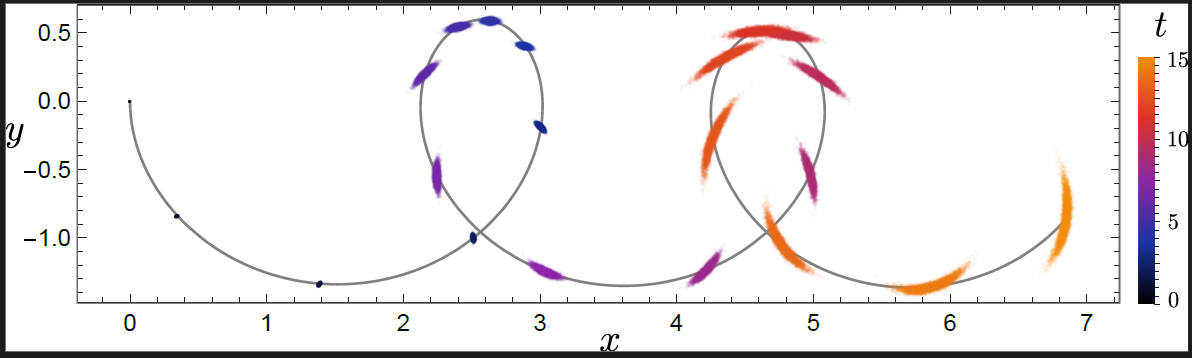
Together with Sriram Ganeshan, I developed a new approach to quantizing nonholonomic systems using ideas from quantum open systems [2607.26146]. The key observation is that a nonholonomic constraint can be realized as the limit of infinitely strong dissipation, which suppresses motion in the forbidden directions. We therefore begin with an unconstrained quantum system coupled to an environment, and recover the desired constrained dynamics in the strong-dissipation limit. This provides a connection between nonholonomic mechanics and the theory of metastability in open quantum systems.
Free energy and kinetic theory from the S‑matrix
The S-matrix should, in principle, encode how a system’s thermodynamics departs from ideal-gas behavior. While the thermodynamic Bethe ansatz captures this connection in integrable models, the Dashen–Ma–Bernstein (DMB) approach extends it to non-integrable systems. I revisited and clarified the DMB formalism, showing how it applies to multiparticle scattering using a set of exactly solvable two-dimensional examples [2408.00729]. More recently, I have been exploring how a version of the DMB formula can be used to derive higher-order corrections to the kinetic equation relevant for wave turbulence.
This topic is directly relevant for the study of confining flux tubes in Yang-Mills. The free energy of an infinitely long flux tube is equivalent to the ground state energy of a finite-length tube, and that may be calculated on the lattice. The ground state energy (and indeed higher levels) may then be connected to the S-matrix in a model of effective string theory. Shortly after my work appeared, DMB was successfully applied to the simplest effective string theory (the D=3 GGRT model) [2408.06729], but much remains to be done for realistic, non-integrable theories.
Skyrmions, strings, and other topological defects
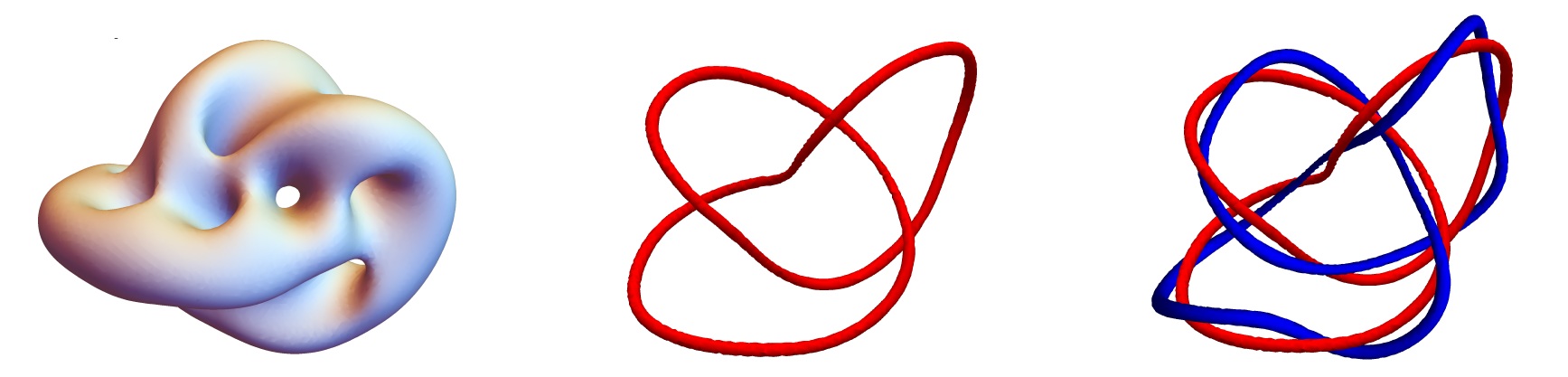
There is an old idea due to Lord Kelvin in the 19th century that distinct atoms might be related to distinct topologies of knotted vortices. Of course today we know nuclei may be described in terms of protons and neutrons, but in [2111.06385] my collaborators and I show that there may be some validity to the idea after all.
Nuclei may be represented as topological defects ("Skyrmions") in an effective field theory for QCD known as the Skyrme model. If we turn instead to magnetic systems, a Skyrmion usually refers to a 2D topological defect, but recent experimental work has produced 3D loops of magnetic Skyrmion strings known as "Hopfions". Our work ties the two notions together. We studied a 3D magnetic system which at a fixed value of control parameter is close to the Skyrme model of QCD. As the parameter is varied, the nuclei-like Skyrmions deform into knotted Hopfions. We further showed that even in the conventional Skyrme model topological charge can be interpreted from this Hopfion viewpoint, and that a Skyrmion can be 'untied' into a long string carrying baryon charge per length.
Relativistic hydrodynamics
I began my theoretical physics career by looking at relativistic fluids and uncovered a connection between a coarse-grained description of cosmic strings and magnetohydrodynamics [1412.3135]. This and my related papers with Vitaly Vanchurin (e.g. [1410.5843]) were formulated in terms of conserved higher-form currents at a time just before the explosion of interest in generalized global symmetries. Subsequent work by other groups re-examined this construction in the modern language of higher-form symmetries [1610.07392] and holography [1707.04182, 1707.08577].
Additional themes
Interdisciplinary theoretical physics
My work draws together methods and ideas from across theoretical physics, from high-energy theory to condensed-matter and fluid dynamics. This breadth makes it easy to communicate with researchers in different areas and to design concrete, accessible projects for students that connect formal theory with observable phenomena.
Low-dimensional QFT as a laboratory
Low-dimensional field theories such as Chern–Simons, sine-Gordon, and SYK form a shared toolkit for theoretical physicists across high-energy, condensed-matter, and statistical physics. These systems provide a controlled setting in which to study non-perturbative effects. In particular, I have worked extensively with non-linear sigma models [2207.10549] and more recently, I have returned to these models from a Monte Carlo perspective, applying machine learning techniques to the two-dimensional O(3) model.
Bridging perturbative and non-perturbative physics
A recurring theme in my research is understanding how perturbative expansions encode non-perturbative physics. In [2107.11017, 2207.10549], using various non-linear sigma models, I showed how a finite truncation of the large-N expansion already contains information about resurgent trans-series in the ordinary coupling. I continue to apply large-N and saddle point methods in much of my work.